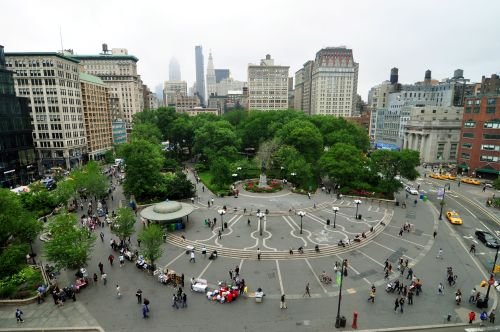
Union Square, New York, NY is the park and plaza between East 14th and East 17th Streets, where Broadway meets Park Avenue South and Fourth Avenue. On any given day it might host a farmers market, a political rally, chess players, skateboarders, and a few hundred thousand subway riders passing underneath, sometimes all within the same hour.
Its name has nothing to do with labor unions or the Civil War, even though both are part of its story.
Union Square Snapshot
| Detail | Information |
| Location | East 14th to East 17th Streets, between Broadway and Fourth Avenue/Park Avenue South |
| Park opened | July 19, 1839 |
| Why “Union” | Named for the union of Bloomingdale Road (Broadway) and Bowery Road (Fourth Avenue) |
| National Historic Landmark | Designated 1997, for its role in American labor history |
| Subway | 14 St–Union Sq (4, 5, 6, L, N, Q, R, W) |
| Greenmarket | Mondays, Wednesdays, Fridays, and Saturdays, 8 a.m.–6 p.m., year-round |
| Congestion toll | Inside Manhattan’s Congestion Relief Zone |
| Upcoming change | City’s 14th Street Plan study, launched March 2026, includes a modernized park |
Not Named for What You’d Think
Many visitors assume “Union” refers to the Union Army or organized labor. It doesn’t. Two of early Manhattan’s main roads met here: Bloomingdale Road, which became Broadway, and Bowery Road, which became Fourth Avenue. The meeting point was called Union Place as early as 1807, and the park that opened in 1839 kept the name.
The coincidence fits well, though. Decades later, Union Square became the country’s best-known gathering place for working people. On September 5, 1882, at least 10,000 workers paraded up Broadway past a reviewing stand at the square in what’s widely recognized as the first Labor Day parade. Twelve years later, Labor Day became a national holiday.
That parade is why the Department of the Interior made Union Square a National Historic Landmark in 1997. The square has continued as a gathering point for strikes, vigils, and protests ever since, including the spontaneous candlelight memorials after September 11, 2001.
Finding Your Way Around the Square
The park is roughly rectangular, and each side has a different feel:
- North end (17th Street): The pavilion, playgrounds, and the main Greenmarket stalls.
- West side (Union Square West): More Greenmarket stalls and the Lincoln statue nearby.
- South end (14th Street): The broad plaza steps, the Washington statue, skateboarders, and street performers.
- Southwest corner: The Gandhi statue in a small garden.
- Across 14th Street to the south: The building with the Metronome and Climate Clock.
Neighborhoods meet here too. Greenwich Village lies to the west and southwest, the East Village to the southeast, Gramercy to the northeast, and the Flatiron District to the north.
How to Get to Union Square, New York, NY
Subway: A True Hub
The 14 St–Union Sq station is one of the busiest in the system, served by eight lines:
- 4, 5, 6: Lexington Avenue lines, with direct service from Grand Central, the Upper East Side, and Lower Manhattan.
- N, Q, R, W: Broadway lines, with direct service from Times Square, Herald Square, Queens, and Brooklyn.
- L: The crosstown line to the West Village, Chelsea, and Williamsburg.
Common routes:
- From Grand Central: The 4, 5, or 6 runs straight down.
- From Times Square: The N, Q, R, or W runs straight down.
- From Penn Station: Walk to 34 St–Herald Square (one avenue east) and take the N, Q, R, or W south.
- From Brooklyn: The L from Williamsburg and the Q or R from many Brooklyn neighborhoods run directly here.
From the Airports
- JFK: Take the AirTrain to Jamaica, then the E train into Manhattan and transfer to a downtown line. A rideshare or taxi is simpler with luggage.
- LaGuardia: Bus connections link to the subway in Queens. Many visitors take a taxi or rideshare.
- Newark: Take NJ Transit to Penn Station, then follow the Penn Station route above.
Buses and the 14th Street Busway
14th Street operates as a busway, with priority for buses and restrictions on private through traffic. The M14 Select Bus Service runs crosstown along it. Several other routes run on Broadway, Park Avenue South, and nearby avenues.
Driving and Cycling
Union Square sits inside Manhattan’s Congestion Relief Zone, so cars entering local streets south of 60th Street pay the daily toll. Combined with the 14th Street busway rules, driving here is rarely worth it. Citi Bike docks surround the park, and protected bike lanes run along several nearby avenues.
Four Statues, Four Eras
- George Washington (south end): Henry Kirke Brown’s equestrian statue, dedicated on July 4, 1856, shows Washington reentering New York on Evacuation Day in 1783, when the British left. It was one of the first major public statues erected in the city since the Revolution and is often described as the oldest sculpture in the city parks collection.
- Abraham Lincoln (north end): Also by Brown, showing Lincoln holding the Emancipation Proclamation. Sources date it to 1868 or 1870, and the statue was originally placed where Gandhi stands today.
- Marquis de Lafayette (east side): By Frédéric-Auguste Bartholdi, the French sculptor who later designed the Statue of Liberty. Its date also varies by source, with 1873 and 1876 both cited.
- Mohandas Gandhi (southwest corner): By Kantilal B. Patel, installed in 1986. It’s one of the most photographed statues in the park, often decorated with flowers.
The James Fountain from 1881, on the park’s west side, is also worth a look.
The Wall That Counts Down
On the south side of 14th Street, facing the park, a huge artwork called Metronome covers part of the building at One Union Square South. Artists Kristin Jones and Andrew Ginzel installed it in 1999. Its digital display originally showed the time of day running forward and backward at the same time.
Since 2020, activists and artists have used the display as the Climate Clock. It counts down the time left before the world uses up the carbon budget for limiting warming to 1.5°C, and it also shows a “lifeline” figure tracking renewable energy. According to its organizers, as of March 2026 the countdown targets July 21, 2029. It’s one of the most striking pieces of public art in the city.
Market Days
The Union Square Greenmarket started in 1976 with a handful of farmers. Today it’s the city’s flagship farmers market. At peak season, around 140 regional farmers, fishers, and bakers sell along the north and west sides of the park.
- Days: Monday, Wednesday, Friday, and Saturday, year-round.
- Hours: 8 a.m. to 6 p.m., though farmers may leave early in bad weather.
- Extras: A compost drop-off runs during market hours, and chefs often lead cooking demonstrations.
Saturday mornings are the busiest and the best for browsing. Wednesdays bring many neighborhood chefs.
What the 14th Street Plan Could Change
The square may change significantly over the next few years. In March 2026, the city’s Department of Transportation launched public planning for The 14th Street Plan, a two-year, $3 million study. The city is contributing $2 million, and the Union Square Partnership and Meatpacking District business groups are contributing the remaining $1 million.
The study aims to:
- Redesign 14th Street: Add landscaping, upgrade pedestrian and plaza space, and make safety improvements while keeping the busway.
- Modernize Union Square Park: Improve accessibility and plazas.
- Connect the corridor: Link streets from Avenue B to the Meatpacking District and Hudson River Park.
No construction schedule has been set. The study is expected to produce capital projects by the time it wraps up. Meanwhile, the Union Square Partnership reported in 2026 that storefront occupancy around the square had risen to about 91 percent.
Steps From the Park
The Strand
A few blocks south on Broadway at 12th Street, this huge independent bookstore is famous for its “18 miles of books” slogan and its sidewalk carts of discounted books.
Tammany Hall
On the east side of the square, the former headquarters of the city’s old Democratic political machine now has a modern glass-and-steel dome on its roof. It’s an unusual mix of old and new architecture.
Flatiron District and Madison Square Park
Walk north on Broadway for about 10 minutes to reach the Flatiron Building and Madison Square Park.
Greenwich Village and Washington Square Park
Head south and west for about 10 minutes to reach Washington Square’s arch and New York University’s campus.
East Village
Walk east along 14th Street and turn south onto Third or Second Avenue for restaurants, bars, and music venues.
Street-Smart Tips
- Pick an exit before you leave the train. The station is large, and exits come up on different corners of the park.
- Shop the Greenmarket early. Popular items sell out by midday, especially on Saturdays.
- Expect gatherings. Rallies and demonstrations happen often, especially on weekends and around major news events.
- Check the holiday market. A seasonal holiday market typically runs at the south end from mid-November through December.
- Watch for skateboarders. The south plaza is a popular skating spot, so walk with some awareness.
Union Square: Things People Ask
Q1. Why is it called Union Square?
A. It’s named for the “union” of two early roads, Bloomingdale Road (now Broadway) and Bowery Road (now Fourth Avenue). The name has nothing to do with the Civil War or labor unions.
Q2. What subway lines stop at Union Square?
A. The 14 St–Union Sq station serves the 4, 5, 6, L, N, Q, R, and W trains. It’s one of the best-connected stations in the city.
Q3. What days is the Union Square Greenmarket open?
A. Mondays, Wednesdays, Fridays, and Saturdays, year-round, from 8 a.m. to 6 p.m. Farmers may leave early in bad weather, and Saturday is usually the busiest day.
Q4. Is Union Square being redesigned?
A. The city launched a two-year planning study in March 2026 for 14th Street and a modernized Union Square Park. Designs and construction dates haven’t been finalized yet.