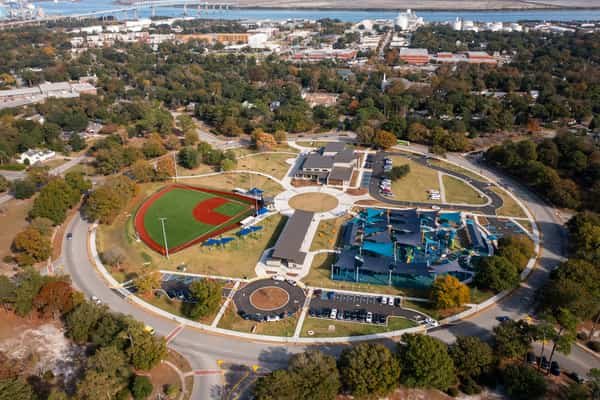
Park Circle, Charleston, SC is a large roundabout with a park in the middle, the center of a 1912 planned “garden city” neighborhood in North Charleston, about a 16-minute drive north of downtown Charleston. Eight streets spread out from it like spokes. Since November 2023, the park inside the circle has held what the city calls the world’s largest inclusive playground.
East Montague Avenue, the neighborhood’s main street, runs from the circle into a lively stretch of restaurants and breweries that has drawn national travel coverage.
Park Circle at a Glance
| Detail | Information |
| City | North Charleston, SC (a separate city from Charleston) |
| Original plan | 1912, designed by William Bell Marquis of the P.J. Berckmans Company, Augusta, Georgia |
| Design idea | Garden City and City Beautiful principles |
| Layout | Circular park with eight streets radiating outward |
| Inner-circle rebuild | About $20 million; construction began September 2022 |
| Grand reopening | November 11, 2023 |
| Playground | 55,000 square feet, 150-plus play elements |
| Playground hours | 7 a.m.–5:30 p.m. per the city (launch reports said dawn to dusk) |
| Main street | East Montague Avenue |
First, Which Charleston?
The search term says “Charleston,” but Park Circle is in North Charleston, its own municipality, incorporated in 1972. Both cities sit in Charleston County and share an airport and a metro area, so most visitors don’t notice the difference. For an address or a navigation app, use North Charleston.
It also helps with expectations. Downtown Charleston has church steeples, cobblestones, and pre–Civil War mansions. Park Circle has mid-century houses, live oaks, craft beer, and a younger, more working-class feel.
A 1912 Plan That Mostly Worked
In June 1912, a group of Charleston businessmen formed the Filbin Corporation and bought 4,650 acres of forest from the Burton Lumber Company, north of the city. Their goal was a new industrial and residential city near the Navy Yard, which had opened in 1901.
They hired the P.J. Berckmans Company, a landscape firm from Augusta, and its designer William Bell Marquis drew up the plan. He followed Britain’s “Garden City” movement, which mixed green space with city life. At the center was a circular park with streets radiating from it.
The full vision didn’t happen. Local historian Nic Butler notes that the original heart of the plan was a segregated upscale neighborhood called Pinewood Park, and that the two companies behind the project collapsed during the 1920s and the Great Depression.
The circle and its streets did get built, though. According to a historical marker, the roughly 1,500-acre neighborhood was completed shortly before World War II and grew quickly with wartime work at the Navy Yard.
The investors left their names on the map. Montague, Rhett, Buist, Durant, and O’Hear Avenues all share names with men behind the 1912 venture.
What’s Inside the Circle Now
For decades, the middle of the circle held an aging community center, a butterfly garden, and a ball field. The city demolished all of it in 2022 and rebuilt the entire interior.
Today the inner circle includes:
- The inclusive playground: A 55,000-square-foot play area designed for children and adults of all physical, sensory, and developmental abilities.
- A community building: Home to the city’s Cultural Arts Department, with an art and rehearsal studio, event space, an artist-in-residence studio, and a history and archives collection.
- An inclusive baseball field: Built so players with disabilities can take part.
- A farmers market pavilion and performance space: Used for markets, concerts, and civic events.
- A nature garden and walking trails: Including the repaved path around the circle.
The playground’s details show how carefully it was designed. Ramps make most structures wheelchair-accessible, and there are charging stations for electric wheelchairs. Shade covers protect against the South Carolina sun, and rubber surfacing cushions falls. The slides are double-insulated metal rather than plastic, a choice that matters to some children with medical devices.
Reported costs vary. Most sources put the inner-circle project at about $20 million. One business publication reported $45 million, a figure that also included about $25 million for upgrades at the nearby Danny Jones Recreation Complex.
Directions to Park Circle, Charleston, SC
From Downtown Charleston
Take I-26 west (signed toward Columbia), exit at Montague Avenue, and head east on East Montague Avenue. It leads straight into the circle. National Geographic described the trip from Marion Square as about a 16-minute rideshare ride, though rush-hour traffic on I-26 can make it much longer.
From Charleston International Airport
Montague Avenue runs from the airport area eastward, crosses I-26, becomes East Montague Avenue, and ends at the circle. Few airports have such a direct route to a neighborhood main street. The drive usually takes 10 to 15 minutes.
By Bus
CARTA buses serve North Charleston. The busiest route, Route 10, runs along nearby Rivers Avenue. A bus rapid transit line called Lowcountry Rapid Transit is planned along Rivers Avenue. It was once expected to open in late 2026, but planners now expect construction to start in 2027, so it isn’t running yet.
Driving the Roundabout
The circle is large and has several exits, so it can confuse first-time drivers. Yield to traffic already in the circle, watch for pedestrians at the crosswalks, and know your exit before entering. Accessible parking is available on the inner circle near the playground and community building.
East Montague Avenue: The Strip Everyone Means
When locals talk about “going to Park Circle,” they usually mean East Montague Avenue. The older buildings along it have filled with independent restaurants and shops:
- EVO Pizzeria: A wood-fired pizza spot often credited with helping spark the strip’s revival.
- The Trade Room and other bars: Casual places popular with neighborhood residents.
- The Butcher & The Brewer: A specialty butcher shop that also hosts pop-up dinners and classes.
- Lola’s: A small shop with pantry items, wine, and fresh pasta.
A Saturday farmers market runs seasonally from spring through fall. One local guide places it near East Montague and Spruill Avenues, while the rebuilt circle now has its own market pavilion. Check current listings for the location before you go.
Worth a Short Drive
Riverfront Park and the Former Navy Base
On the Cooper River, part of the former Charleston Navy Base now has walking paths, public art, and open lawns. It’s a reminder of the Navy Yard that shaped Park Circle’s early growth.
H.L. Hunley Submarine
The Civil War submarine Hunley is being conserved at the Warren Lasch Conservation Center on the former Navy Base. Public tours have run mainly on weekends, so check the schedule first.
Breweries and Distilleries
North Charleston has several craft breweries and distilleries, including Holy City Brewing and Firefly Distillery. Some host live music and food trucks.
North Charleston Coliseum and Performing Arts Center
This concert and event complex is a short drive away, near Tanger Outlets and the airport.
Downtown Charleston
When you’re ready for the historic district, Marion Square, King Street, and the Battery are a 15- to 25-minute drive south, depending on traffic.
Small Things That Make a Visit Easier
- Check playground hours. The city lists 7 a.m. to 5:30 p.m., while early coverage said dawn to dusk.
- Plan for quieter times. The playground is busiest on weekend mornings, and children with sensory sensitivities may do better on weekday afternoons.
- Bring water and sunscreen. Shade covers help, but summer heat is intense.
- Know the rules. The city doesn’t allow grills, inflatables, or other equipment that could damage the grounds.
- Combine park and dinner. Many families spend the afternoon at the playground, then walk to East Montague Avenue for an early meal.
Park Circle Q&A
Q1. Is Park Circle in Charleston or North Charleston?
A. Park Circle is in North Charleston, a separate city incorporated in 1972. It is part of the greater Charleston metropolitan area and is roughly a 16-minute drive from downtown Charleston, depending on traffic.
Q2. What’s inside Park Circle?
A. The inner circle includes an inclusive playground, a community building for the city’s Cultural Arts Department, an inclusive baseball field, a farmers market pavilion, a nature garden, and walking trails. These facilities opened in November 2023.
Q3. How big is the Park Circle playground?
A. The Park Circle playground covers approximately 55,000 square feet and offers more than 150 play activities. The city describes it as the world’s largest inclusive playground, designed for visitors of different abilities.
Q4. How do I get to Park Circle from the airport?
A. From the airport area, follow Montague Avenue east, cross I-26, and continue onto East Montague Avenue, which leads directly to Park Circle. The drive generally takes about 10–15 minutes, depending on traffic.
Q5. Who designed Park Circle?
A. Park Circle was designed in 1912 by William Bell Marquis of Augusta’s P.J. Berckmans Company using Garden City planning principles. The original plan featured a central circular park with eight streets radiating outward.