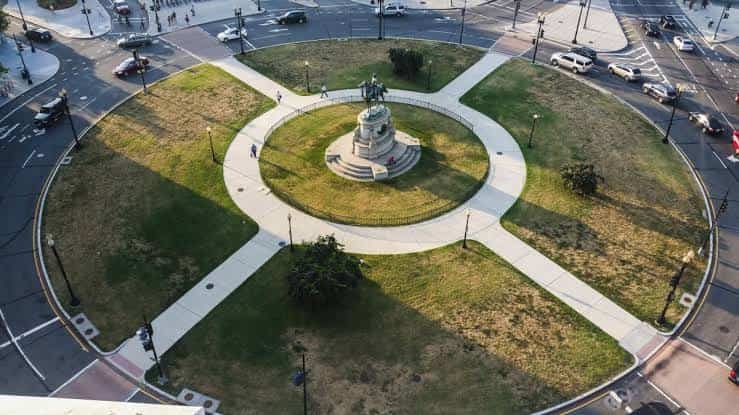
Washington Circle, Washington, D.C. is where Pennsylvania Avenue, New Hampshire Avenue, K Street, and 23rd Street NW meet on the northwest corner of George Washington University’s campus. The Foggy Bottom–GWU Metro station is a two-minute walk south, GW Hospital’s front door faces the circle, and Georgetown starts a few blocks west.
In the middle of the traffic stands a bronze George Washington on a rearing horse, leading his troops at the Battle of Princeton. Congress first voted to honor him with a statue in 1783. It took 77 years to actually build one.
Washington Circle Essentials
| Detail | Information |
| Location | Foggy Bottom / West End, Northwest D.C. |
| Streets that meet | Pennsylvania Avenue, New Hampshire Avenue, K Street, 23rd Street NW |
| Park size | 2.19 acres (federal Reservation No. 26) |
| Central monument | Equestrian statue of George Washington by Clark Mills |
| Dedicated | February 22, 1860, Washington’s birthday, by President James Buchanan |
| Below ground | K Street underpass for through traffic |
| Managed by | National Park Service |
| Nearest Metro | Foggy Bottom–GWU (Blue, Orange, Silver Lines) |
| Major neighbors | George Washington University, GW Hospital, hotels along the circle |
A Campus Corner, a Hospital Door, and a Park
Most people who walk past Washington Circle are on their way to class, a hospital visit, or a train. Students cut across it between dorms. Medical staff and patients cross 23rd Street at all hours. Hotel guests from the two hotels that face the circle step out onto it every morning.
The park itself is calm compared with the traffic around it. Two concentric paths ring a central lawn, with the statue in the middle. That layout dates back to the 19th century, and the circle still follows it closely.
It also has a claim most visitors never hear about. Pierre L’Enfant included the circle in his 1791 plan, and it became the first of Washington’s circles to be landscaped as a public park. The Foggy Bottom Association dates that work to 1856.
How to Get to Washington Circle, Washington, D.C.
Metro Is the Easiest Option
The Foggy Bottom–GWU station sits at 23rd and I Streets, just south of the circle, directly outside the hospital entrance. Walk north on 23rd Street for about a block and you’re there.
The station serves three lines, which makes the circle easy to reach from almost anywhere:
- Blue Line: Direct from Reagan National Airport, Arlington Cemetery, and Alexandria.
- Orange Line: Direct from Arlington’s Rosslyn–Ballston corridor and from Capitol Hill.
- Silver Line: Direct from Dulles Airport and Reston.
Starting From Union Station
Take the Red Line to Metro Center. Switch to any westbound Blue, Orange, or Silver train and ride three stops to Foggy Bottom–GWU. Most of the trip is spent waiting for the transfer, not riding.
On Foot From Dupont or Georgetown
- From Dupont Circle: New Hampshire Avenue runs diagonally southwest from Dupont Circle straight to Washington Circle. It’s about 15 minutes on foot through quiet West End blocks.
- From Georgetown: Walk east on M Street or Pennsylvania Avenue, cross the bridge over Rock Creek, and you’ll reach the circle in roughly 10 to 15 minutes.
- From the White House: Pennsylvania Avenue leads northwest to the circle in about 20 minutes.
Driving and the K Street Underpass
Through traffic on K Street passes beneath the circle, so you won’t see it from the surface. Use the surface ring only to turn onto Pennsylvania Avenue, New Hampshire Avenue, or 23rd Street.
The circle sits close to I-66, Rock Creek Parkway, and the Whitehurst Freeway, so it works well as a driving entry point from Virginia. Parking is a different story. Street spaces around a university and a hospital fill up fast. Garages near 23rd Street and the hotels are the more reliable option.
Washington at Princeton, Cast on the Ellipse
Clark Mills got the commission after his statue of Andrew Jackson in Lafayette Square became a hit. That Jackson statue was the first equestrian statue cast in the United States. Congress authorized Mills’s Washington statue on January 25, 1853, at a cost of $60,000.
Mills chose a specific moment: the Battle of Princeton on January 3, 1777, with Washington calm in the saddle while his horse rears beneath him. Mills cast the statue at his own foundry near the Ellipse, the same foundry that later cast the Statue of Freedom on top of the Capitol dome.
The timing of the dedication carries some weight. President Buchanan unveiled a statue of the general who unified the colonies on February 22, 1860. Fourteen months later, the Civil War began.
The statue has also had to make way for traffic. It was removed for construction of the K Street underpass and later put back. Sources disagree on when that happened. One account says the statue returned in 1936. Another dates the underpass to the early 1960s and the statue’s return to 1963. It’s possible both describe separate road projects, but the record isn’t clear.
From “Round Tops” to Campus Lawn
Foggy Bottom wasn’t always polished. In the 19th century, breweries, lime kilns, and a gasworks filled the area with smoke, which helps explain the neighborhood’s name. A GW publication notes that the area around Washington Circle was once nicknamed “Round Tops,” after an Irish gang that controlled it.
During the Civil War, a Union supply depot called Camp Fry sat just south of the circle. Over the following century, the land around the circle held a British legation, an orphan asylum, schools, and even a statue company that reportedly displayed a giant figure of Bacchus.
George Washington University’s move to Foggy Bottom changed the area completely. Today the circle marks the northwest edge of the campus.
Places Within Reach
Foggy Bottom Historic District
A few blocks southwest, between 24th and 26th Streets, narrow brick rowhouses that once housed brewery and gasworks laborers still line the streets. The district was established in 1987 and is one of the best-preserved working-class neighborhoods in the city.
Godey Lime Kilns
Near 27th and K Streets, almost under a highway on-ramp, sit the ruins of 19th-century lime kilns. Workers burned limestone brought down the C&O Canal here to make lime and plaster for construction. It’s an odd, quiet relic of Foggy Bottom’s industrial past.
Georgetown
Cross Rock Creek on Pennsylvania Avenue and you’re on M Street, with its shops, restaurants, and the C&O Canal towpath.
Kennedy Center: Check Before You Go
The Kennedy Center sits about 10 minutes south of the circle, down New Hampshire Avenue. Its main building has been closed since September 15, 2026, when its board voted to shut it for renovations. As of October 1, NBC News reported that it remained closed pending safety assessments, with no reopening date announced.
The REACH, the smaller separate building on the campus, is still hosting free events Thursday through Sunday. The center’s name has also been the subject of a federal court dispute. A judge ruled in May 2026 that only Congress can change it, and the Trump name was removed from the facade in June.
The Watergate Complex
The Watergate’s curved buildings sit along the Potomac near the Kennedy Center. They’re a short walk from the circle and well-known for their history.
Smart Moves for Visitors
- Visit early or on weekends. Weekday rush hour fills the surface ring with traffic from the hospital, campus, and K Street commuters.
- Use the inner path for photos. The central lawn gives a clean view of the rearing horse without cars in the frame.
- Plan around hospital traffic. Ambulances use 23rd Street frequently, so give emergency vehicles room at the crosswalks.
- Pair it with Georgetown. The circle makes a natural starting point for an afternoon walk west.
- Verify Kennedy Center plans the same day. Its status has changed several times in 2026.
Questions Visitors Ask
Q1. What Metro stop is closest to Washington Circle?
Foggy Bottom–GWU on the Blue, Orange, and Silver Lines. Exit onto 23rd Street and walk one short block north to reach the circle.
Q2. What does the Washington Circle statue show?
Clark Mills’s bronze shows George Washington at the Battle of Princeton in January 1777, calm on a rearing horse. It was dedicated on February 22, 1860.
Q3. Is Washington Circle part of George Washington University?
Not technically. The National Park Service owns and manages the park. It sits at the northwest corner of GWU’s campus, though, so students treat it as a campus landmark.
Q4. How far is Georgetown from Washington Circle?
Roughly 10 to 15 minutes on foot. Head west on Pennsylvania Avenue or M Street and cross the Rock Creek bridge into Georgetown’s main shopping streets.
Q5. Is the Kennedy Center open near Washington Circle?
Its main building has been closed since September 15, 2026, with no announced reopening date. The separate REACH building still hosts free events on weekends.