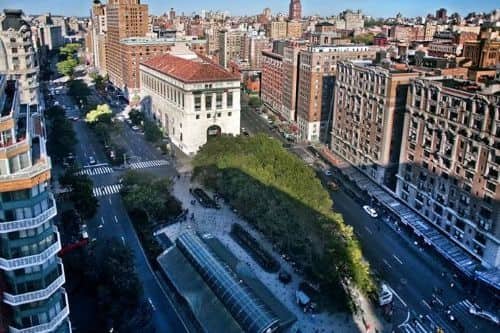
Verdi Square, New York, NY is a tiny park on the Upper West Side, wedged between Broadway, Amsterdam Avenue, and West 72nd and 73rd Streets. At about a tenth of an acre, it’s smaller than many apartment lobbies. Yet it holds a 25-foot marble monument to Giuseppe Verdi, a modern subway entrance, and one of the city’s rare scenic-landmark designations.
Thousands of people pass it every day on their way into the 72nd Street station. Few stop to notice that four of Verdi’s opera characters are standing guard around him.
Verdi Square in Brief
| Detail | Information |
| Location | Broadway and Amsterdam Avenue, West 72nd to 73rd Streets, Upper West Side |
| Size | About 0.1 acre, a trapezoidal traffic island |
| Acquired by the city | 1887 |
| Named for Verdi | 1921 |
| Monument | Verdi Monument by Pasquale Civiletti, 1906; about 25 feet 9 inches tall |
| Landmark status | Designated a New York City Scenic Landmark in 1974 |
| Subway | 72 St (1, 2, 3), directly beneath the square |
| Southern neighbor | Sherman Square, the matching triangle across 72nd Street |
| Annual event | Verdi Square Festival of the Arts, with free concerts every September |
A Small Island at a Big Intersection
Broadway runs diagonally across Manhattan’s grid, and wherever it crosses an avenue at an angle, small leftover triangles appear. At 72nd Street, Broadway crosses Amsterdam Avenue, leaving a pair of them: Sherman Square to the south and Verdi Square to the north.
Verdi Square has an extra distinction. It’s the northernmost spot where Broadway crosses an avenue diagonally. North of here, Broadway straightens out and runs parallel to the grid.
The land has history too. This stretch of Broadway was once Bloomingdale Road, which opened in 1703 and ran through the old village of Harsenville, an area of country houses well before the Upper West Side existed.
Originally a simple triangle, the park was enlarged when the subway station was rebuilt in 2002. That’s why it’s now shaped more like a trapezoid.
The Composer and His Cast
The monument was a project of Carlo Barsotti, founder and editor of the Italian-language newspaper Il Progresso Italo-Americano. He used the paper to raise money from Italian immigrants for a series of public monuments, including the Columbus statue at Columbus Circle. Verdi, who died in 1901, was next.
Sicilian sculptor Pasquale Civiletti carved the monument from Carrara marble and Montechiaro limestone. Verdi stands at the top, in a suit with an overcoat over his arm. Below him are four life-size figures from his operas:
- Falstaff: The comic knight from Verdi’s final opera.
- Leonora: The heroine of La Forza del Destino.
- Aida: The Ethiopian princess from his best-known opera.
- Otello: Shakespeare’s Moor in Verdi’s musical version.
The dedication was timed for Columbus Day 1906, but sources disagree on the exact date. NYC Parks materials variously list October 11, 12, and 13. All agree that a parade of Italian societies marched from Washington Square up to Broadway and 72nd Street for the event.
In the early 1900s, the square became an informal gathering place for musicians. Tenor Enrico Caruso and conductor Arturo Toscanini were among those said to have spent time there.
From “Needle Park” to Neighborhood Garden
The square went through hard decades. By the 1960s and 1970s, heroin dealing and use around the 72nd Street intersection earned the area the nickname “Needle Park.”
The name came from the 1971 film The Panic in Needle Park, starring Al Pacino. Here’s a detail many people don’t know: the film was mostly set and shot at Sherman Square, the bare traffic island just south across 72nd Street. Verdi Square ended up sharing the nickname because it was right next door.
The turnaround came gradually. Neighborhood volunteers began reclaiming the park in the late 1980s. The monument, which had deteriorated badly, was conserved in 1996 and 1997. Today a local nonprofit, Friends of Verdi Square, looks after the plantings and runs the September arts festival.
Getting to Verdi Square, New York, NY
By Subway
The 72 St station on the 1, 2, and 3 lines sits directly underneath the square. It’s an express stop, so it’s fast from almost anywhere along the West Side:
- From Times Square: Take the 2 or 3 express one stop north.
- From Penn Station: The 1, 2, and 3 all run directly to 72nd Street from 34 St–Penn Station.
- From Grand Central: Take the shuttle to Times Square, then transfer to the 2 or 3.
- From Lower Manhattan: The 2 and 3 run express from Wall Street and Chambers Street.
Coming from JFK Airport, take the AirTrain to Howard Beach, then the A train to 59 St–Columbus Circle, and transfer to the 1 train for two stops north.
By Bus
The M72 crosstown bus runs along 72nd Street and connects to the East Side through Central Park. The M104 runs along Broadway. Several other routes use Amsterdam and Columbus Avenues, so check the MTA trip planner for current schedules.
By Car or Bike
Verdi Square is well north of 60th Street, so driving here doesn’t trigger Manhattan’s congestion toll. Street parking on the Upper West Side is difficult, though, and garages fill up on show nights at the Beacon Theatre. Citi Bike docks are located around 72nd Street, and Riverside Park’s greenway is a few blocks west.
Two Subway Houses, One Century Apart
Stand on the square and look south across 72nd Street. In the Broadway median, you’ll see a small brick-and-limestone building with a curved roof. That’s the original 1904 control house, one of the few surviving subway entrance buildings from the city’s first subway line. It’s a designated landmark.
For nearly 100 years, it was the station’s only entrance. In 2002, the MTA renovated the station and built a second, glass-roofed station house on the north side of 72nd Street, inside an expanded Verdi Square.
There’s also a lesser-known detail. Near the newer station house stands an ornate bronze lamppost with lions’ heads at the base and goats’ heads near the top. It originally stood at the Firemen’s Memorial on Riverside Drive at 100th Street. After vandalism in the 1980s, it was removed and stored, then restored and installed at Verdi Square in 2004. Its twin is still in storage.
Around the Square
The Ansonia
On Broadway at 73rd Street, this Beaux-Arts apartment building with mansard roofs and corner turrets was completed in 1904. It has long been associated with musicians and opera singers, which makes it a fitting neighbor for Verdi.
Beacon Theatre
Two blocks north on Broadway, this 1929 theater with a lavish interior hosts concerts, comedy shows, and other events. Its marquee is easy to spot from the square.
The Dakota and Strawberry Fields
Walk east along 72nd Street for about 10 minutes to reach the Dakota apartment building at Central Park West. Across the street inside Central Park is Strawberry Fields, the memorial to John Lennon.
Riverside Park
Head west on 72nd Street for about 10 minutes to reach Riverside Park and its Hudson River paths.
Lincoln Center
About six blocks south on Broadway, or one subway stop on the 1 train, at 66th Street.
Make the Most of a Short Stop
- Walk all the way around the monument. Each character faces a different direction, and the details are easy to miss from one side.
- Come in September. The Festival of the Arts brings free concerts into the square.
- Mind the hours. Friends of Verdi Square says the seating area is open during daylight hours, though some listings describe the square as open 24 hours.
- Compare both station houses. The 1904 and 2002 entrances face each other across 72nd Street.
- Visit Sherman Square too. It’s the real setting of The Panic in Needle Park, though there’s little to see there today.
Your Verdi Square Questions
Q1. What subway station is at Verdi Square?
A. The 72nd Street subway station on the 1, 2, and 3 lines is directly beneath Verdi Square. The 2 and 3 trains run express, making Times Square just one stop away.
Q2. Is Verdi Square the “Needle Park” from the movie?
A. Partly. The “Needle Park” nickname was associated with both Verdi Square and nearby Sherman Square during the 1970s. However, The Panic in Needle Park was mainly filmed around Sherman Square, the triangular public space just south across 72nd Street.
Q3. Who are the figures around the Verdi statue?
A. The four figures represent characters from Giuseppe Verdi’s operas: Falstaff, Leonora from La Forza del Destino, Aida, and Otello. Sculptor Pasquale Civiletti carved the marble monument, which was unveiled in 1906.

