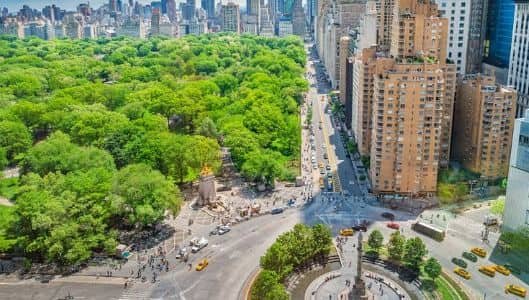
Columbus Circle, New York, NY is the busy traffic circle at the southwest corner of Central Park, where Broadway, Eighth Avenue, Central Park South, and Central Park West meet at 59th Street. Christopher Columbus stands on a column about 70 feet above the traffic, surrounded by glass towers, park gates, and one of Manhattan’s busiest subway stations.
It’s also the official center of New York City. Distances to and from the city are measured from this point, which makes it Manhattan’s mile zero.
Columbus Circle Quick Facts
| Detail | Information |
| Location | Southwest corner of Central Park, Midtown West/Upper West Side border |
| Streets that meet | Broadway, Eighth Avenue, Central Park South (59th Street), Central Park West |
| Monument | Columbus Monument by Gaetano Russo, unveiled October 12, 1892 |
| Monument height | About 76 feet total; sources put the marble statue at 13 to 14 feet |
| Traffic circle design | William Phelps Eno, completed around 1905 |
| Last major redesign | 2005, with a new granite plaza, benches, and perimeter fountains |
| Subway | 59 St–Columbus Circle (A, B, C, D, 1) |
| Special status | The official point from which New York City distances are measured |
| Congestion toll | Inside Manhattan’s Congestion Relief Zone (at and below 60th Street) |
Where the Grid Breaks
Manhattan’s street grid is mostly straight lines and right angles, but Broadway runs diagonally across it. Columbus Circle is where Broadway crosses Eighth Avenue and 59th Street at the corner of Central Park, and the circle turns that awkward intersection into a roundabout.
North of the circle, Eighth Avenue becomes Central Park West. To the east, 59th Street becomes Central Park South, lined with hotels facing the park. Broadway keeps heading northwest toward Lincoln Center and the Upper West Side.
The neighborhoods change in every direction:
- North: The Upper West Side and Lincoln Center.
- East: Central Park South, then the luxury towers of “Billionaires’ Row” along 57th Street.
- South: Hell’s Kitchen and the Theater District around Times Square.
- Northeast: Central Park, through the Merchants’ Gate entrance.
A Monument Paid for by Immigrants
In 1892, New York marked the 400th anniversary of Columbus’s first voyage. Italian immigrants, who faced heavy discrimination at the time, wanted to contribute something permanent.
The Italian-language newspaper Il Progresso led the fundraising, and Italian-American businessmen across the country raised most of the $20,000 cost. Sicilian sculptor Gaetano Russo carved the statue and other elements in Italy, and the finished monument arrived by ship in September 1892.
About 10,000 people attended the dedication on October 12, 1892. Russo’s design includes:
- The statue: Columbus in Carrara marble at the top of a granite column.
- The column: Bronze reliefs of ships projecting from its sides.
- The base: An allegorical marble figure, the Genius of Discovery, holding a globe.
- Bronze details: Two reliefs showing Columbus’s journey, plus an American eagle.
The monument has also drawn ongoing debate over how Columbus should be remembered, particularly during the national monument controversies of 2017 and the following years. It remains in place and is listed on the National Register of Historic Places. For many Italian Americans, it’s still a symbol of their community’s history in New York.
The Day Columbus Got a Living Room
In 2012, artist Tatzu Nishi built a temporary apartment around the top of the statue for the Public Art Fund. Visitors climbed six flights of scaffolding stairs into a fully furnished living room with a sofa, a television, and wallpaper. In the middle of the room stood the 13-foot marble Columbus, close enough to touch.
It was the only time in the monument’s history when the public could see the statue up close at eye level. Photos from that project still circulate online.
Getting to Columbus Circle, New York, NY
By Subway
The 59 St–Columbus Circle station, under the circle itself, is one of the busiest in the system:
- A and D: Express trains with fast connections from Midtown, Brooklyn, and the Bronx.
- B and C: Local service on Central Park West and Eighth Avenue (B trains run weekdays).
- 1: Broadway local service from Times Square, the Upper West Side, and Lower Manhattan.
The station has several exits around the circle. One entrance runs through the Deutsche Bank Center, and its escalators were out of service for a long stretch in 2024 and 2025. Check MTA service alerts before relying on them.
From Major Transit Hubs
- Times Square: Take the 1 train two stops north, or walk about 15 minutes up Broadway.
- Penn Station: Take the A or C uptown from 34 St–Penn Station. The A express gets there fastest.
- Grand Central: Take the shuttle to Times Square, then transfer to the 1 train.
- Port Authority Bus Terminal: Take the A or C uptown from 42 St.
- JFK Airport: Take the AirTrain to Howard Beach, then the A train directly to 59 St. It’s a long but transfer-free subway ride.
Buses and Citi Bike
Several MTA bus routes run along Broadway, Eighth Avenue, and Central Park South, and stop around the circle. Check the MTA trip planner for current routes. Citi Bike docks are spread around the area, and the Central Park loop drive is car-free, which makes the park easy to explore by bike.
Driving
Columbus Circle sits right on the edge of Manhattan’s Congestion Relief Zone. Driving onto local streets at or below 60th Street triggers the congestion toll once per day. The program remains in effect after a federal judge ruled in March 2026 that the federal government’s attempt to revoke it was unlawful.
Garages in and around the Deutsche Bank Center are available, but most visitors are better off taking the subway. Rideshare trips that start, end, or pass through the zone also carry a congestion surcharge.
Buildings That Ring the Circle
- Deutsche Bank Center (10 Columbus Circle): The twin glass towers, formerly the Time Warner Center, hold The Shops at Columbus Circle, restaurants, offices, and Jazz at Lincoln Center’s performance spaces.
- Museum of Arts and Design (2 Columbus Circle): Craft, design, and contemporary art exhibits. It also hosts the GatherNYC Sunday concert series.
- 1 Central Park West: A hotel and residential tower at the circle’s north side.
- Merchants’ Gate and the USS Maine Monument: A gilded memorial at the park entrance, completed in 1913, honoring sailors killed in the 1898 explosion of the battleship Maine.
Places Within a Short Walk
Central Park
Enter through Merchants’ Gate on the circle’s northeast side. Within minutes you’re on paths leading to Heckscher Playground, the Sheep Meadow, and the Central Park Carousel.
Lincoln Center
Walk north on Broadway or Columbus Avenue to 62nd Street, about seven or eight minutes, to reach the plaza and its famous fountain. It’s home to the Metropolitan Opera, New York Philharmonic, and New York City Ballet.
Carnegie Hall
Two blocks south and two avenues east, at 57th Street and Seventh Avenue. Carnegie Hall opened in 1891, a year before the Columbus Monument.
Hearst Tower
At 57th Street and Eighth Avenue, Norman Foster’s diagonal glass tower rises out of the original 1928 stone building. It’s one of Midtown’s most unusual pieces of architecture.
Times Square and the Theater District
Head down Broadway about 15 minutes south to reach Broadway theaters, Times Square, and Hell’s Kitchen’s restaurant blocks.
Timing Tips for This Week
Columbus Day weekend falls this week. The traditional wreath-laying ceremony at the monument is scheduled for Sunday, October 11, 2026, and the Columbus Day Parade runs on Fifth Avenue on Monday, October 12. Expect crowds and some security restrictions around the circle on Sunday.
General tips:
- Rest at the plaza. Benches and fountains around the monument make a convenient break between the park and Midtown.
- Find the mile-zero marker. Look at the monument’s base and remember that every official distance from New York City starts here.
- Expect demonstrations. The circle is a common gathering spot for protests and rallies, especially on weekends.
- Use the mall restrooms. The Shops at Columbus Circle has the most reliable public facilities nearby.
- Watch for winter events. The Shops at Columbus Circle and nearby areas often host seasonal markets and decorations in November and December.
Columbus Circle FAQ
Q1. What subway lines stop at Columbus Circle?
The 59 St–Columbus Circle station serves the A, B, C, D, and 1 trains. B trains run on weekdays only. Exits open in several directions around the circle.
Q2. Why are New York distances measured from Columbus Circle?
The circle serves as the city’s official reference point, so mileage signs and official distances to New York City are calculated from here. It works as Manhattan’s mile zero.
Q3. Is Columbus Circle inside the congestion pricing zone?
Yes. The zone covers Manhattan’s local streets at and below 60th Street, and the circle sits at 59th. Drivers entering pay the toll once per day.
Q4. Who built the Columbus Circle monument?
Sicilian sculptor Gaetano Russo created it, and New York’s Italian-American community funded it. It was unveiled on October 12, 1892, the 400th anniversary of Columbus’s first voyage.
Q5. What’s the best way to enter Central Park from Columbus Circle?
Use Merchants’ Gate on the circle’s northeast side, next to the gilded USS Maine Monument. Paths lead quickly to playgrounds, meadows, and the Central Park Carousel.
Q6. What’s inside the Deutsche Bank Center at Columbus Circle?
The former Time Warner Center holds The Shops at Columbus Circle, restaurants, offices, a hotel, and Jazz at Lincoln Center’s concert spaces, with direct access to the subway.