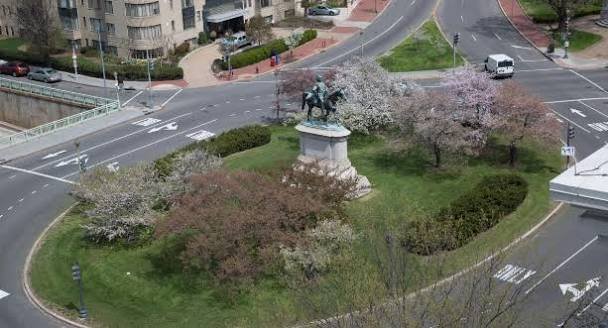
Scott Circle, Washington, D.C. holds three monuments, two parks, one tunnel, and a statue of a horse that started a family argument. It sits where Massachusetts Avenue, Rhode Island Avenue, and 16th Street NW meet, about a kilometer north of the White House. On a clear day, you can look straight down 16th Street and see the White House from the circle.
Most people only pass through it on the way to somewhere else. Stop for ten minutes, though, and Scott Circle turns out to be one of the most story-packed intersections in the city.
Scott Circle at a Glance
| Detail | Information |
| Location | Northwest D.C., between downtown and Dupont Circle |
| Streets that meet | 16th Street, Massachusetts Avenue, Rhode Island Avenue NW (N Street connects via Bataan and Corregidor Streets) |
| Central monument | Equestrian statue of Lt. Gen. Winfield Scott, erected 1874 |
| Side memorials | Daniel Webster (west) and Samuel Hahnemann (east), both from 1900 |
| Tunnel | 16th Street underpass, opened December 29, 1941 |
| Major neighbor | Embassy of Australia, rebuilt and reopened August 2023 |
| Historic district | Sixteenth Street Historic District |
| Closest Metro | Farragut North (Red), Dupont Circle (Red), McPherson Square (Blue/Orange/Silver) |
The Horse That Started an Argument
Winfield Scott was the U.S. Army’s commanding general longer than anyone else in its history. He served under every president from Thomas Jefferson to Abraham Lincoln and fought in the War of 1812, the Mexican–American War, and the opening months of the Civil War. His troops nicknamed him “Old Fuss and Feathers” for his love of formal uniforms.
Congress authorized a statue in 1867, the year after he died. Sculptor Henry Kirke Brown got the job, and the government handed over bronze cannons Scott’s soldiers had captured during the Mexico City campaign to be melted down for it.
Then came the problem. Scott preferred riding mares, so Brown modeled the horse as a small mare. Shortly before casting, Scott’s family protested. No other American general, they argued, had been shown on a mare.
Brown was annoyed and made only minimal changes. He added stallion anatomy to the existing figure and left the rest alone. The result is a tall, heavy general sitting on a horse that looks noticeably too small for him. Once you know the story, it’s hard to stop seeing it.
The statue was installed in 1874 with no formal ceremony. It became the first Civil War–era general’s monument placed in one of Washington’s circles. Nearly twenty more would follow across the city.
Where Scott Circle Sits on the Map
Picture 16th Street as a straight line running north from the White House. Scott Circle sits on that line between M Street and O Street, where Massachusetts and Rhode Island Avenues cross it on the diagonal.
Embassy Row begins right at its northwest edge, at the new Australian Embassy. Logan Circle and 14th Street lie a few blocks east, and Dupont Circle is about ten minutes’ walk west along Massachusetts Avenue.
N Street doesn’t actually reach the circle from either side. Two short connector streets, Bataan Street and Corregidor Street, link it to the surrounding avenues. They’re easy to miss on a map.
Directions to Scott Circle, Washington, D.C.
Nearest Metro Stops
There’s no station on the circle itself. Three stations are each roughly a 10-minute walk away, depending on which exit you use:
- Farragut North (Red Line): Walk north on 17th Street or Connecticut Avenue, then cut east on M Street or Rhode Island Avenue.
- Dupont Circle (Red Line): Use the south entrance and head southeast down Massachusetts Avenue.
- McPherson Square (Blue, Orange, Silver): Exit toward 15th Street and walk north on 16th Street.
Coming From Further Away
- Reagan National Airport: Take the Blue Line to McPherson Square with no transfer, then walk north on 16th Street.
- Union Station: Take the Red Line toward Shady Grove and get off at Farragut North or Dupont Circle.
- Dulles Airport: The Silver Line runs directly to McPherson Square.
Driving Through the 16th Street Tunnel
Through traffic on 16th Street drops into an underpass and passes beneath the circle entirely. Use the outer service lanes only if you need to turn onto Massachusetts or Rhode Island Avenue.
The tunnel has its own small bit of trivia. Construction began in February 1941, and it opened on December 29, 1941. Historical accounts say the D.C. commissioners planned to ride the first car through, but several cars, a truck, and a bus overtook them. One historic-preservation report lists the tunnel work as running from 1941 into 1942, so sources differ slightly on the exact dates.
Parking is mostly in office and hotel garages. Weekday street spots are very hard to find.
Walking From the Other Circles
- From Thomas Circle: About two blocks west along Massachusetts Avenue.
- From Logan Circle: Head southwest on Rhode Island Avenue for roughly 10 minutes.
- From Dupont Circle: Follow Massachusetts Avenue southeast for about 10 minutes.
Two Statues on the Sidelines
Scott gets the center, but the two small triangular parks on either side are easier to reach and more rewarding up close.
Daniel Webster Memorial
On the west side stands a 12-foot bronze Daniel Webster atop an 18-foot granite pedestal, unveiled on January 18, 1900. Italian sculptor Gaetano Trentanove showed the senator and Secretary of State mid-speech. Stilson Hutchins, a New Hampshire native, paid for it, and it stands close to where Webster once lived.
Samuel Hahnemann Memorial
Across the circle on the east side is a surprise: a large memorial to the German doctor who founded homeopathy. The American Institute of Homeopathy donated it, and it was dedicated on June 21, 1900. Charles Henry Niehaus sculpted a seated Hahnemann in front of a curved wall with four bronze relief panels. They show him as a student, a chemist, a teacher, and a physician at a patient’s bedside.
Look for the German inscription carved into it: Die milde Macht ist gross, which means “gentle power is great.” It’s one of very few German-language inscriptions on a public monument in the capital, and a reminder of how popular homeopathy was in America in 1900.
Worth the Detour Nearby
Embassy of Australia
Australia tore down its 1960s embassy on the circle’s northwest corner and replaced it with a copper-and-glass building designed by Bates Smart. The new embassy opened in August 2023. Its main entrance faces south toward the White House. According to the embassy, the green roof is home to an apiary of roughly 240,000 bees. You can’t tour the building, but its reddish copper facade is striking from the sidewalk.
National Geographic Museum of Exploration
A block west at 17th and M Streets, National Geographic reopened its headquarters museum on June 26, 2026, after nearly four years of construction. The new museum covers more than 100,000 square feet and includes immersive exhibits and a large theater. That’s about five times the size of the old galleries.
Metropolitan AME Church
At 1518 M Street, just south of the circle, stands a red-brick Victorian Gothic church completed in 1886. Frederick Douglass worshipped here, and his funeral was held here in 1895. A century later, the national memorial service for Rosa Parks took place in the same sanctuary.
The 16th Street Sightline
Walk to the circle’s southern edge and look south. L’Enfant designed 16th Street to frame a direct view toward the White House and Lafayette Square, and that view still works. It’s about a 15-minute walk if you want to follow it.
Practical Pointers
- View Scott from the side parks. Traffic surrounds the central island, so the Webster and Hahnemann parks are the best places to see the statue.
- Look closely at the horse. Now that you know the backstory, check the proportions between the rider and his mount.
- Combine three circles in one walk. Scott, Thomas, and Logan Circles together make an easy one-hour loop with three Civil War–era statues.
- Check museum hours before going. The National Geographic museum uses timed tickets, so book ahead for weekends.
- Watch the merges. Cars leaving the 16th Street tunnel come up quickly at the service-lane junctions.
Scott Circle Questions, Answered
Q1. What is the closest Metro station to Scott Circle?
Farragut North, Dupont Circle, and McPherson Square are each about 10 minutes away on foot. Farragut North and Dupont Circle are both on the Red Line.
Q2. Why is the horse at Scott Circle unusual?
The sculptor originally modeled a mare, which Scott preferred to ride. His family objected, so the sculptor added stallion features to the existing design. That’s why the horse looks small for its rider.
Q3. What embassy is at Scott Circle?
The Embassy of Australia stands at 1601 Massachusetts Avenue on the northwest corner. Its new copper-clad building opened in August 2023 and marks the start of Embassy Row.
Q4. Can you see the White House from Scott Circle?
Yes. Look south straight down 16th Street from the circle’s southern edge. The White House is about a kilometer away, and L’Enfant designed the street to frame that view.