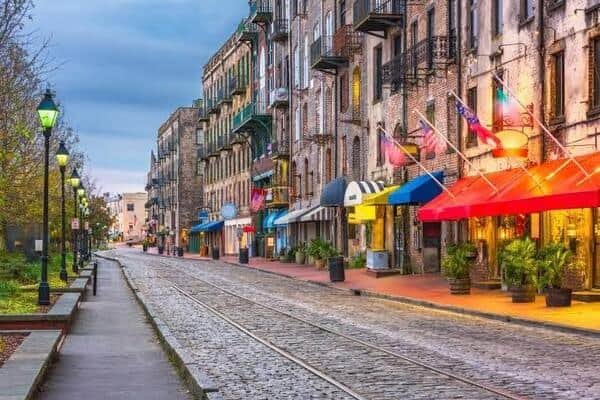
What visitors usually encounter instead is the city’s distinctive network of historic squares—small landscaped public spaces built into Savannah’s street grid. Twenty-two of the original 24 squares survive, forming one of the defining features of the Savannah Historic District.
Rather than having one central “Savannah Circle,” Downtown Savannah contains squares at regular intervals. Johnson Square, Wright Square, Chippewa Square, Madison Square, Monterey Square, Reynolds Square, Lafayette Square, and others can all be explored on foot. For a first-time visitor, Johnson Square or Chippewa Square provides a much more useful navigation point than searching for “Savannah Circle.”
Savannah Historic Area at a Glance
| Detail | Information |
|---|---|
| “Savannah Circle” | No prominent official place verified |
| Actual city feature | Historic public squares |
| Surviving historic squares | 22 |
| Original city plan | Began in 1733 |
| Historic planner | James Oglethorpe |
| Oldest square | Johnson Square |
| Central walking corridor | Bull Street |
| Major nearby park | Forsyth Park |
| Northern landmark | Savannah River |
| Popular square | Chippewa Square |
| Main visitor area | Savannah Historic District |
| Best navigation choice | Specific square or attraction |
Is There an Actual Savannah Circle?
An exact search does not establish Savannah Circle as a recognized central Savannah street or public roundabout.
Savannah’s urban plan uses squares rather than circles. The original city plan developed around wards, with each ward containing a central public square. Civic or institutional “trust lots” were placed east and west of a square, while residential lots were arranged around the rest of the ward.
The first squares were established when Savannah was founded in 1733. As the city expanded, the same planning system was repeated. Twenty-two squares survive today; Elbert and Liberty squares were lost, while Ellis Square was eventually restored.
This makes Savannah quite different from cities where a single traffic circle acts as the main civic center.
Where Are Savannah’s Historic Squares?
The squares are concentrated throughout the Savannah Historic District, which extends roughly from the Savannah River south to Gwinnett Street and from Martin Luther King Jr. Boulevard east to East Broad Street.
One of the easiest ways to understand their layout is to follow Bull Street.
Walking south from the riverfront area, Bull Street passes through Johnson Square, Wright Square, Chippewa Square, Madison Square, and Monterey Square before reaching the Forsyth Park area.
Other rows of squares are found along Barnard, Abercorn, Habersham, Houston, and nearby streets.
Why Does Savannah Have So Many Squares?
Savannah’s unusual street pattern dates to its founding.
James Oglethorpe established Savannah in 1733 using a ward-based town plan. Each ward contained a central square intended to function as community open space, while surrounding lots were allocated for residential and civic uses.
As Savannah expanded during the 18th and 19th centuries, new wards and squares were added while retaining the basic planning concept.
The Historic District was designated a National Historic Landmark District in 1966 in recognition of this urban plan and the surrounding historic architecture.
Today, the squares remain functional public parks rather than simply historic remnants.
Getting to Savannah’s Historic Squares
From Savannah/Hilton Head International Airport
From the airport, drive east toward Downtown Savannah using I-16.
I-16 leads directly toward the western side of the historic downtown area. Once downtown, use a specific square, hotel, museum, or parking garage as your GPS destination rather than “Savannah Circle.”
From I-16
I-16 is the main interstate approach into central Savannah from the west.
The highway terminates near Downtown Savannah, making it convenient for reaching the Historic District. From there, Martin Luther King Jr. Boulevard and surrounding streets provide access to the western side of downtown.
From River Street
If you are already at Savannah’s riverfront, walk south toward Bay Street and the historic squares.
Johnson Square, the oldest of Savannah’s squares, is only a few blocks from the river and makes a practical starting point for a walking tour. From there, continue south along Bull Street toward Wright, Chippewa, Madison, and Monterey squares.
From Forsyth Park
Forsyth Park is at the southern end of the main visitor corridor.
From the park’s famous fountain, walk north along Bull Street. Monterey Square is the first major historic square encountered, followed by Madison, Chippewa, Wright, and Johnson squares as you continue toward the river.
Squares to Visit in Downtown Savannah
Johnson Square
Johnson Square is the oldest of Savannah’s public squares and dates to 1733. It is located along Bull Street near the northern part of the Historic District. Its prominent monument honors Revolutionary War general Nathanael Greene.
Wright Square
Continue south on Bull Street to reach Wright Square. The square contains a memorial to Tomochichi, the Yamacraw leader who played an important role during the establishment of colonial Savannah.
Chippewa Square
Chippewa Square is one of Savannah’s best-known squares. Its centerpiece is a monument to James Oglethorpe. The square also became widely recognizable as the location used for the bench scenes in Forrest Gump, although the movie’s bench itself was a prop.
Madison Square
Madison Square lies farther south along Bull Street. It was laid out in 1837 and contains the monument to Sergeant William Jasper. Historic properties surrounding the square add to its architectural character.
Monterey Square
Monterey Square is close to Forsyth Park and contains the Pulaski Monument. The Mercer Williams House is also located on the square, making this one of the better-known stops in the southern Historic District.
Places Near Savannah’s Squares
Forsyth Park
Forsyth Park is the large green space at the southern end of the Historic District visitor corridor. The 30-acre park is famous for its cast-iron fountain, walking paths, lawns, and oak trees.
River Street
River Street forms Savannah’s historic waterfront. The nine-block riverfront promenade is lined with restored former cotton warehouses that now contain shops, galleries, restaurants, and other visitor businesses.
City Market
City Market occupies four blocks in the heart of the Historic District. Its restored buildings contain shops, galleries, cafés, and restaurants, making it an easy addition to a walking route through the western squares.
Cathedral Basilica of St. John the Baptist
The Cathedral Basilica stands beside Lafayette Square at 222 East Harris Street. It is one of the Historic District’s most recognizable architectural landmarks.
Victorian District
South of the main Historic District is Savannah’s Victorian District, an area known for colorful late-19th-century houses. Unlike the older downtown plan, this district was developed without the same network of original squares.
Tips for Exploring Savannah’s Squares
- Search for a specific square instead of “Savannah Circle.” Johnson, Chippewa, or Monterey Square are useful choices.
- Use Bull Street for a simple walking route. Five major historic squares are positioned along this corridor.
- Combine the squares with Forsyth Park. Walking from Johnson Square south to Forsyth Park gives visitors a good introduction to the historic city layout.
- Wear comfortable shoes. Historic sidewalks can include brick and uneven surfaces.
- Park once when possible. The Historic District is compact enough to explore many attractions on foot.
- Remember that the squares are public spaces but surrounding buildings may be private homes.
Savannah Circle Questions
Q1. Is Savannah Circle a real place in Savannah, Georgia?
A. I could not verify a prominent official Savannah street or public traffic circle named Savannah Circle. Savannah is instead famous for its network of historic public squares.
Q2. How many historic squares does Savannah have?
A. Twenty-two of Savannah’s original 24 squares survive today. The city’s square-based layout began with James Oglethorpe’s town plan in 1733.
Q3. Which Savannah square should first-time visitors see?
A. Chippewa Square is one of the best-known, while Johnson Square is the oldest. Walking along Bull Street lets visitors see Johnson, Wright, Chippewa, Madison, and Monterey squares on one route.
Q4. What places are near Savannah’s historic squares?
A. Major nearby destinations include Forsyth Park, River Street, City Market, the Cathedral Basilica, historic house museums, and the Savannah riverfront. Most central attractions can be combined with a walking tour of the squares.